
Podcast: Play in new window | Download (Duration: 12:57 — 24.1MB) | Embed
Subscribe or Follow Spotify | Android | Pandora | iHeartRadio | TuneIn | Deezer | RSS | More
What if the biggest problem in digital advertising isn’t whether your ads are working… but whether anyone seeing them is actually human?
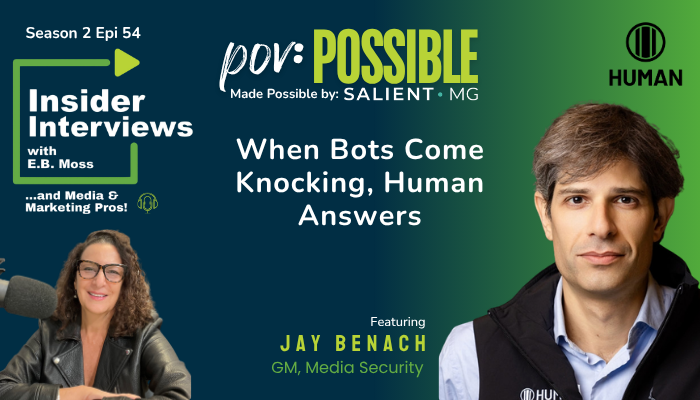
For another in my POV: Possible mini-series from Miami, Jay Benach, GM of Media Security at Human, explains how their company is helping brands distinguish between real people, useful bots, and the sophisticated automated activity flooding the internet. And after this conversation, I’m not sure I’ll ever look at traffic metrics, “viewable” impressions, or even shopping cart activity quite the same way again.
Human, a company whose name alone tells you everything about what they stand for, has a backstory worth knowing: they started as Bot or Not, LLC, evolved into White Ops, and ultimately landed on Human Security, because the mission today is more than fraud prevention. They’re aiming to help brands identify the real and right humans interacting with their business.
Jay came to this work after a video game network, where he was seeing, ah, certain publishers delivering suspiciously large audiences at suspicious speed. When he was introduced to the founders of what was then BotOrNot, it clicked. The technology could identify with precision whether a browser session was being operated by a real person or automated by a script, and pretty damn quickly.
 Now a full platform, when Jay was faced with my “Pitch Me, Pinch Me” segment, he delivered maybe the shortest and most effective elevator pitches I’ve heard yet:
“Do you want to know if you’re being robbed?”
I was sold in one sentence.
But there’s more! One of the most eye-opening parts, literally, of our discussion was Jay’s explanation that “viewable” doesn’t necessarily mean “human.” Years ago, viewability standards were created to ensure ads actually appeared onscreen. But fraudsters adapted quickly. Bots were engineered to scroll pages, move cursors, and mimic engagement patterns convincing enough to satisfy traditional measurement systems. Technically, the ad was “seen.” Just not by anyone you’d want to reach.
“The question is no longer ‘Is this a bot?’ It’s ‘Who sent it, and what does it want?’” — Jay Benach
And the problem has evolved well beyond ad fraud. Today, brands are contending with sniping bots that fill shopping carts to skew retargeting data, competitor-hired bots that drain paid search budgets by clicking ads, and LLM crawlers scraping sites to feed AI models. The question has shifted from “is this a bot?” to “what kind of bot is this, who sent it, and what does it want?” As Jay put it, it’s like asking whether you have a good witch or a bad witch at the door — and Human is the one who can tell you.
Then there’s a twist: not every bot is bad.
A shopping comparison bot acting on behalf of a real consumer might actually represent purchase intent. The skill, or “vertical learning curve”, as Jay calls it, is knowing which is which, and optimizing accordingly. You can’t simply block automation. Instead, marketers now have to understand which automated activity represents fraud, which represents opportunity, and how to optimize for both humans and the “good bots” helping humans make decisions.

I thought this was interesting, too: Jay’s take on advertising within LLMs is that unlike banner blindness or skipped search ads, an ad surfaced in the context of an active AI conversation is embedded in dialogue. “I can target my money to spend where there’s the highest level of intent and precision,” he says. By next November, he predicts, it’ll be significantly better than it is today. And that’s what’s adding to the changing definition of “audience” faster than most brands realize.
Yikes.
Key Moments
- 0:00:59 — Jay Benach, GM of Media Security at Human: From Bot or Not to Human — the origin story behind the name
- 0:02:47 — Jay’s gaming industry backstory — and the sus audiences that led him here
- 0:00:59 — Jay Benach, GM of Media Security at Human: From Bot or Not to Human — the origin story behind the name
- 0:02:47 — Jay’s gaming industry backstory — and the sus audiences that led him here
- 0:04:59 — How the bot conversation has changed over the last 12 years
- 0:06:21 — Good bots, bad bots, and the “marionette” controlling them
- 0:09:23 — Why LLMs are fueling an explosion of bot activity across the web
- 0:09:32 — Advertising inside LLMs: Jay’s take on the next precision ad buy
- 0:12:01 — Pitch Me, Pinch Me: “Do you want to know if you’re being robbed?”
- 0:13:16 — “Viewable” doesn’t mean human: How bots learned to game ad metrics
- 0:17:41 — Why filtering out fraud can actually improve marketing performance
- 0:18:30 — Sniping bots, drained ad budgets, and hidden threats in e-commerce metrics
- 0:22:30 — The Human Side: Serving the good bots — and the vertical learning curve for marketers
Visit humansecurity.com to learn more.
Connect with E.B. Moss and Insider Interviews: With Media & Marketing Experts
LinkedIn: https://www.linkedin.com/in/mossappeal
Instagram: https://www.instagram.com/insiderinterviews
Facebook: https://www.facebook.com/InsiderInterviewsPodcast/
Threads: https://www.threads.net/@insiderinterviews
If you enjoyed this episode, follow Insider Interviews on @YouTube, @Apple or @Spotify or your favorite app, AND please share with another smart business leader, and leave a comment, a like … or a tip in my jar!: https://buymeacoffee.com/mossappeal!